Spalling concrete foundation repair Brisbane: what to know first
By Artigellence ·
Spalling is concrete breaking apart because the steel inside it is rusting, so patching the surface without dealing with the rust treats only the symptom. If the job needs space on council land, Brisbane City Council's 2026-27 schedule lists a Zone C application at $184.00. Heritage listing and building approval can also change how you go about the work.
Call (07) 3523 1792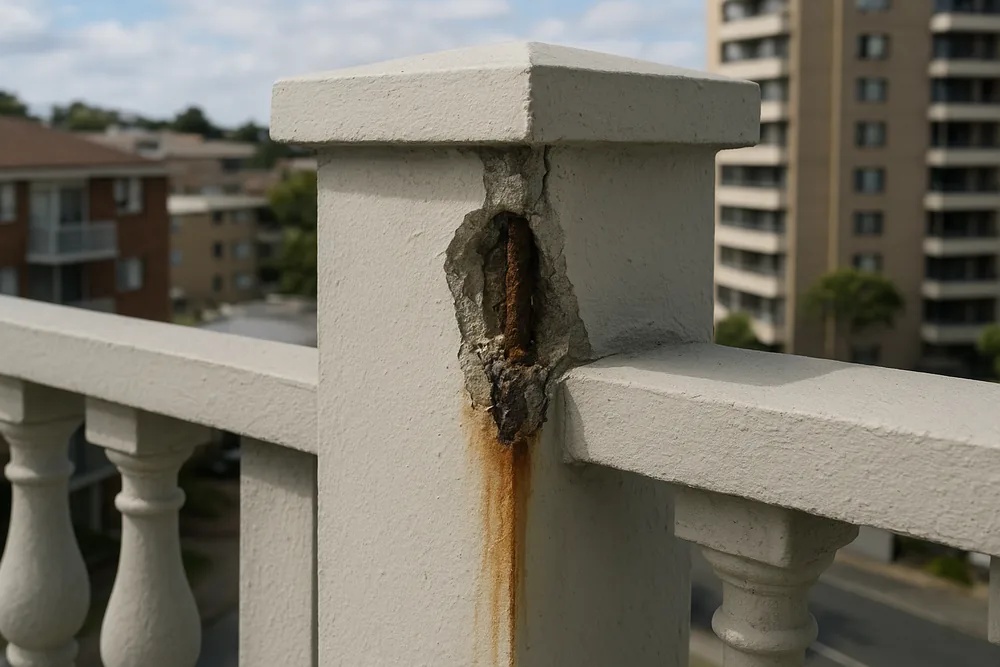
What spalling actually is
Spalling is the name for concrete fracturing apart, and it is the process people know as concrete cancer. The flaking, chunks and exposed steel you see are the end result of something that started out of sight.
The trigger is water. If the concrete has cracks or pores, water can seep in and react with the steel reinforcing to form rust. Rust takes up more room than the steel it came from, and the steel is also the part of the member doing the strength work, so the damage is both a volume problem and a loss-of-strength problem.
Once rust starts pushing, it forces cracks wider, and wider cracks let in more water. That loop is why spalling tends to get worse rather than stay put, and why a cosmetic patch over rusting steel is a poor bet.
Foundations, older buildings and what the evidence covers
The sources behind this article describe how the damage works in reinforced concrete. They do not single out foundations, so this post makes no claim about how a below-ground footing behaves differently from a balcony slab or a column. What they do say is that concrete cancer remains a major concern in older buildings, which is worth knowing if yours is an older Brisbane house, unit block or retaining structure.
In practice that means the first job is working out where the water is getting in and how far the rust has travelled, not choosing a repair product. Our concrete cancer inspection page covers the warning signs to look for.
Heritage listing can change the approach
A local heritage place is a private or public property protected under Brisbane City Plan 2014 for its contribution to the city's past. If your building is one, check before you start cutting out concrete.
Brisbane City Council publishes a General Exemption Certificate for local heritage places. It covers minor repair, removal, replacement and structural reinforcement of damaged or deteriorated elements, but only when the existing element can no longer be conserved. The same document lists testing concrete strength to determine serviceable life or weight bearing capacity among the works it covers. Whether your particular repair fits within it is a question for the council or a heritage-aware professional, not something to assume.
Approvals, access and council fees
Brisbane City Council says you need building approval before starting extensions, raising and renovations, and it points householders to a licensed building certifier for advice. If a repair grows into something closer to a renovation, that is the person to ask.
Some jobs also need temporary structures. The council's application form for working on council property includes hoarding and gantry, which it describes as a temporary fence around a building or structure under repair, or temporary scaffolding. If you are in the Zone C part of Brisbane, meaning other areas as identified in City Plan 2014, the 2026-27 schedule of fees lists each application at $184.00. A separate line sets a permit charge of $3.20 per square metre of space used per week. The central city zone is higher, at $369.00 per application. The schedule also states that GST does not apply to any fees, so those amounts are the full amounts listed.
Noise rules matter too. The council's out-of-hours construction page says concrete and asphalt cutting must be done during the day, which affects how a crew can schedule breaking out damaged concrete.
Artigellence is the marketing business that operates this site and writes its articles. It does not carry out the work described.
Thanks — we have your enquiry. Someone will be in touch shortly. Prefer to talk now? Call (07) 3523 1792.
Last reviewed · Updated · First published